
India's Textile Heritage Isn't Behind Glass

Updated: May 4

About two years ago, I had an epiphany while travelling in India, immersed in textiles. I realised textiles here are not decorative. Heritage textiles can be found in a museum, of course, and preserving fading crafts is a worthwhile endeavour. But my epiphany? Textiles are just a part of everyday life here in India.

Textiles aren't part of life in a grand, museum-plaque sort of way. Craft conservation and appreciation exist in India, but somehow the day-to-day experience of living with this craft doesn't seem to be a big deal.
That is, in the sense that you look around and realise people are wearing history, sitting on it, drying it in the sun, folding it into cupboards, passing it down for generations without ceremony.
I remember being in Sanganer, just outside Jaipur, in a block printing workshop that didn’t feel like it was trying to impress anyone. No polished displays, no careful staging, just long wooden tables, trays of dye, and stacks of carved blocks that had clearly been used thousands of times. And the printers? They weren’t explaining much. They were just working, allowing me to watch and kindly guiding me with a word or a nod.

One man was printing a repeat pattern so quickly and precisely that I found myself looking for the grid lines, some kind of pencil mark, a guide, anything. There was nothing. Just years of practice and a kind of muscle memory that made it look almost suspiciously easy.
(It’s not. I tried. It was not pretty.)

What struck me wasn’t just the skill, it was the ease of it. This wasn’t being performed for visitors. This was a normal day in which I was fortunate enough to be part of. The same techniques his father likely used, and his father before that, are still moving forward without needing to be preserved or “revived” because they never disappeared in the first place.
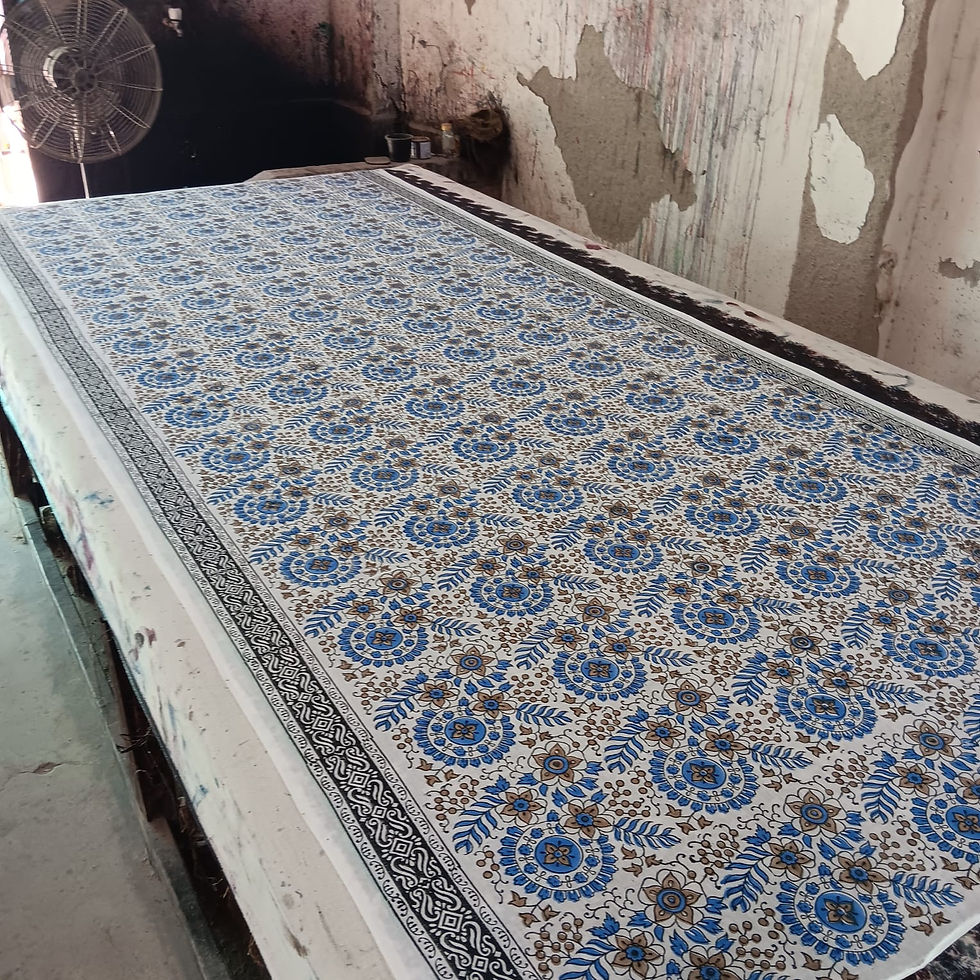
And that brings me back to my moment of epiphany. In many places, textile heritage is something you go to see. In India, you sort of trip over it. It’s embedded in daily life in a way that doesn’t ask for attention, which somehow makes it more compelling when you do start paying attention. And after you pay attention, you'll see heritage everywhere all at once.
It gets harder to look at textiles the same way again. You start noticing things. The slight misalignment in a hand-printed repeat. The variation in dye where the pressure changed just a bit. The fact that no two pieces are ever identical, even when they’re trying to be.
Machines, of course, have gotten very good at imitating this. Almost annoyingly good. There are plenty of pieces now that look handmade at a glance and sometimes even at a second glance. But there’s still a difference. You feel it before you fully understand it. (And that’s something I’ll get into more, because it’s worth knowing what to look for.)
Travelling through India with textiles as a lens changes your pace without you trying. You linger longer. You ask more questions. You start to understand that what you’re being shown isn’t just a finished product, it's about heritage and craft, about process, a rhythm, a set of decisions made by hand, over and over again.

It also means accepting that things aren’t always polished. Workshops can be dusty. Schedules are flexible in a way that would make most Western planners slightly anxious. But that’s part of what keeps it deeply real.
Its heritage is still in motion.
And once you see that, it’s hard to go back to thinking of textiles as just something decorative to buy.


Comments